A movement field guide
Inside
a step.
See how the parts relate. Understand two ideas about balance. Bring one clear question to your own movement.
Start with the foot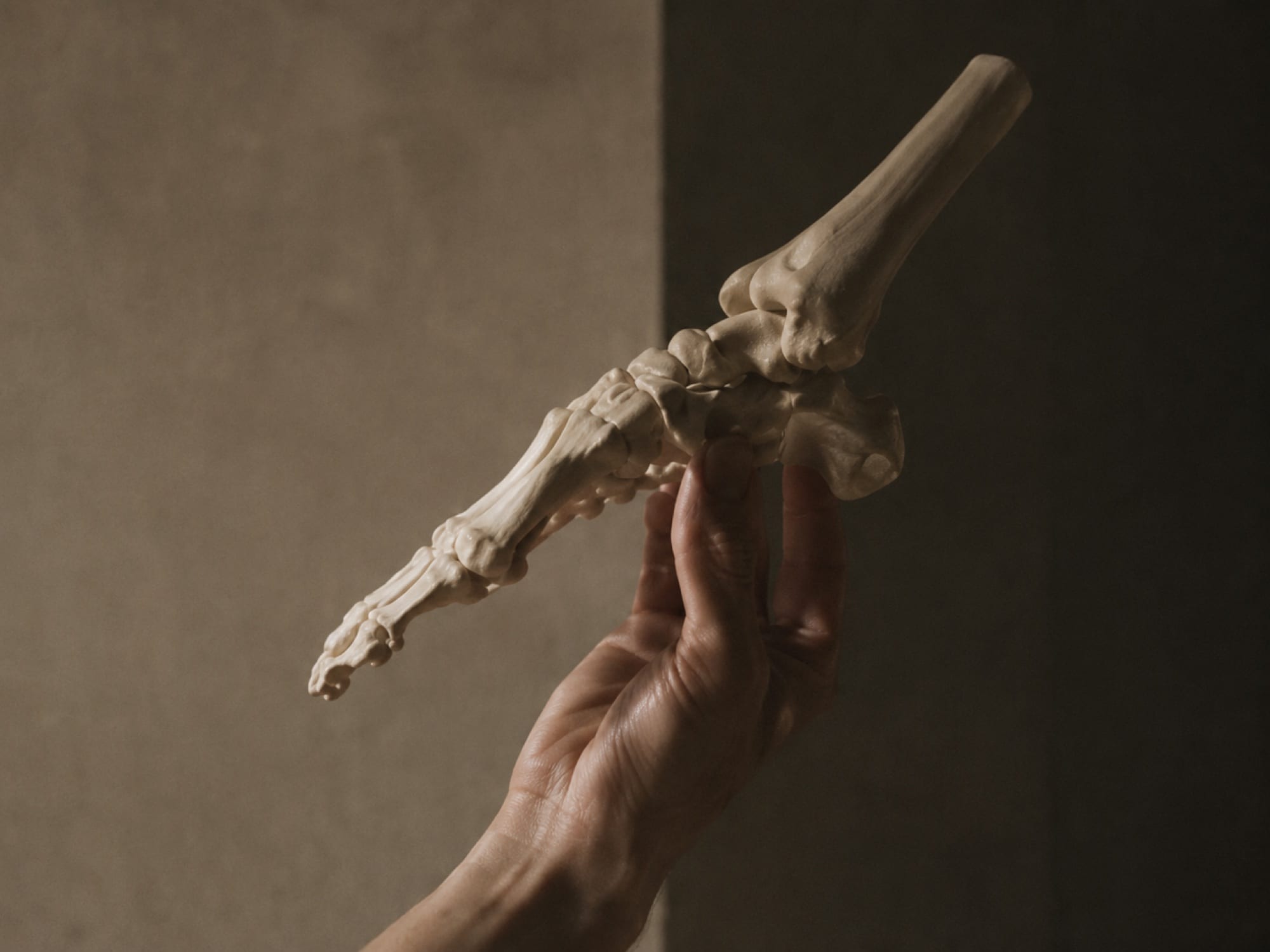
01 · The moving foot
More than
an arch.
Different parts of the foot move relative to one another during a step.
- Heel
- The heel bone forms the back of the foot.
- Midfoot
- Joints in this region are part of how the foot changes shape under load.
- Forefoot
- The front of the foot can move relative to the rearfoot as contact changes.
What about pronation?
Pronation and supination describe combined movement in three planes. Arch height alone does not capture that motion.
This photograph shows structure. It does not animate pronation or assess your movement.
Sources behind the explanation
- Lundgren et al. · 2008
Bone-mounted markers recorded motion within the foot during walking in six participants.
- Eichelberger et al. · 2018
A walking study examined movement between foot segments and changes around the arch in asymptomatic adults.
These sources support the explanation. They do not establish that this app’s explorations improve movement.
02 · Mass and support
Two ideas.
Different meanings.
Balance involves body movement and the support available as you move.
- Center of mass
- The average location of the body’s mass. Its location depends on how that mass is distributed.
- Center of pressure
- On level ground, the point representing the combined upward support force.
Where you feel contact cannot locate either point. This app records your experience, without measuring your center of mass or center of pressure.
Sources behind the explanation
- MacKinnon & Winter · 1993
A laboratory study used cameras and force platforms to study whole-body balance during walking.
- Vieira et al. · 2021
A gait-initiation experiment examined center of pressure and center of mass as distinct quantities.
These sources support the explanation. They do not establish that this app’s explorations improve movement.
03 · Your comparison
One question.
Then return.
Understanding movement starts with a useful question. Where does contact feel clearest? Which direction feels easier? Choose one comfortable task and give it a starting description.
- 01
Notice
Describe one familiar task.
- 02
Try
Explore one small variation.
- 03
Return
Repeat your original task.
- 04
Compare
Keep both answers and the context.
Use the same task, surface, footwear and support when you return. Keep any changed conditions with your record. Same, different and not sure are all useful answers; none proves that your mechanics improved.
Explore ground contactA framework for asking questions
The whole body
stays in view.
Gary Ward’s Anatomy in Motion and Flow Motion Model consider whole-body movement through a step. Inyo draws on that perspective while keeping research, framework interpretations and the work still in development distinct.
How we use evidenceWhy you may hear “four domains”
Inyo’s exploration vocabulary includes foot contact alongside forward/back, side-to-side and turning movement. Foot contact is an extra domain to explore, not a fourth anatomical plane.
Gary’s public model describes movement in three anatomical planes. The archetype assessment is still being refined; it does not select these explorations.
Gary’s description of the Flow Motion ModelThe exact prototype instructions and mechanics need Gary’s review. The studies linked here do not validate the app or its outcomes.
Read about making a comparison